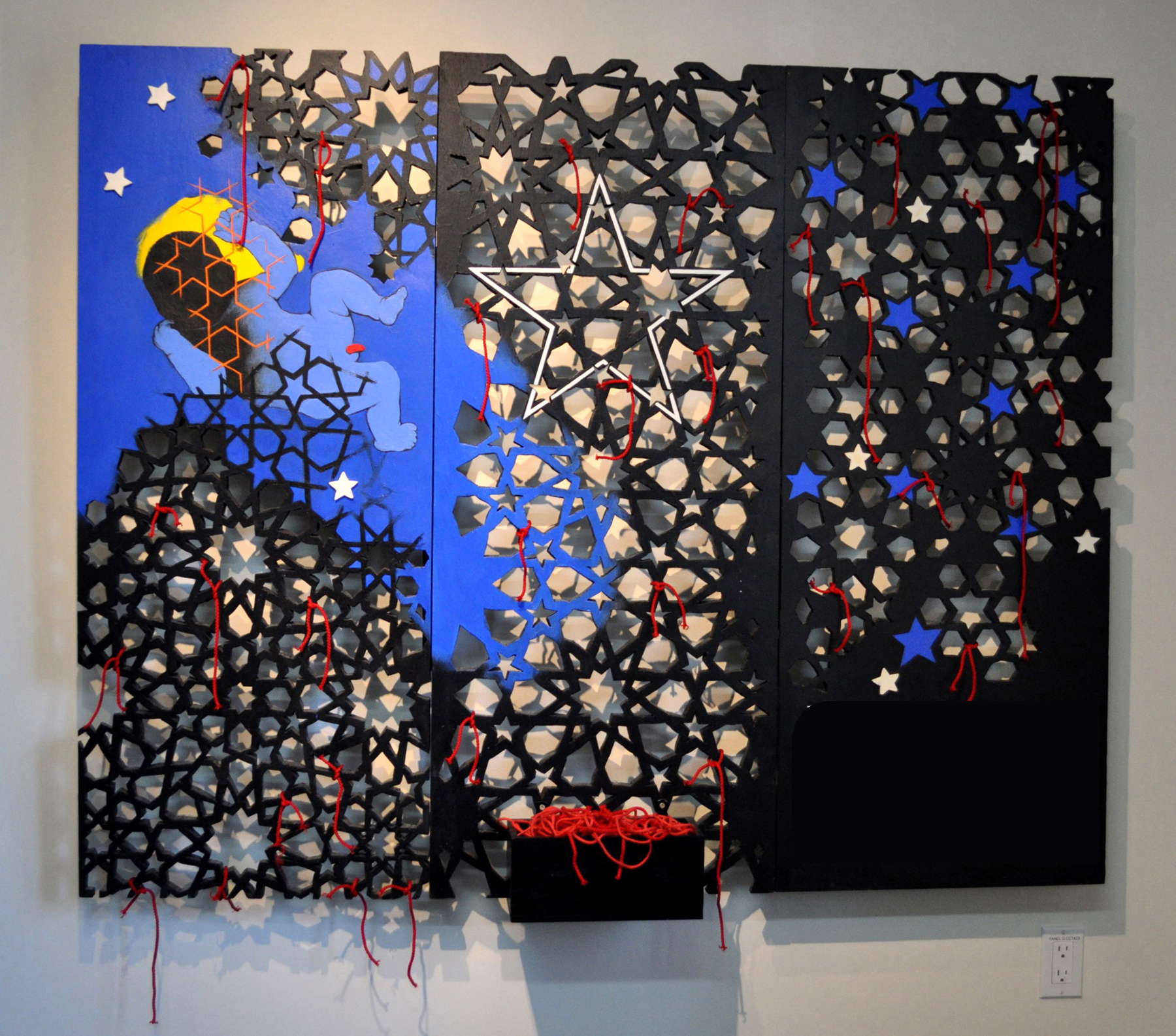
Dargah (2010)
Dargah, the installation project unfolds as a layered site of devotion, geometry, and contradiction. Composed of three carved wooden panels that function as both image and object, the work resists a fixed orientation: shifting between wall and floor, between the verticality of reverence and the horizontality of offering. Its surface draws from early Islamic design principles, where intricate star patterns emerge through precise geometric construction. These forms, historically associated with spiritual order and infinite expansion, become here both aesthetic and symbolic frameworks, suggesting a cosmos governed by harmony, yet inhabited by deeply human inequities.
At the center of the installation, a box filled with red threads invites participation. This gesture references the ritual practice at the shrine of Salim Chisti in Ajmer, where devotees tie threads onto marble screens as embodiments of their wishes. In this work, the threads accumulate not as anonymous acts of faith, but as a dense archive of longing, each strand standing in for an unspoken desire, a plea, or a loss. The viewer is drawn into this field of suspended intention, made to sense the emotional weight carried by millions who seek intervention, hope, or fulfillment through sacred means.
Yet beneath this language of devotion lies a critical tension. The work confronts the persistent reality of gender bias across South and East Asia, particularly the violence of female foeticide and the systemic devaluation of the girl child. The historical narrative of Emperor Akbar seeking a male heir through divine blessing becomes a point of entry into a broader cultural pattern, where spiritual practices and social structures often intersect to reinforce patriarchal desires. The same site that promises miracles also becomes a mirror, reflecting deeply ingrained hierarchies of gender and worth.
Dargah operates in this space of paradox, where faith and injustice coexist, where beauty and violence are intricately bound. The geometric precision of the carved surfaces contrasts with the visceral presence of the threads, creating a dialogue between order and rupture. In doing so, the work asks: what does it mean to seek fulfillment in a system that selectively values life? And how might the act of witnessing transform our understanding of belief, tradition, and responsibility?
Through its material, form, and participatory element, Dargah becomes not only an object of contemplation but a site of encounter, where the viewer is implicated in the tension between sacred aspiration and social reality.